

To my clients and community readers, this article will be a bit more “inside baseball” than about the game of money itself. For those interested in what financial planners and adjacent professionals discuss, debate, and think about, it might be an interesting read. For those inclined to read for things to learn about personal finance, investing, or the economy at large, this might be a skip for you, and that’s okay. Just remember to get out and vote, it’s election day!
~~~
There’s been a fair bit of discussion about planner compensation and costs carried by clients as of late. Most delightfully, it’s not been the usual grumbling and gnashing of teeth over AUM fees versus other business models, or arguing fee-only versus commission, and all the other annoying buzzing that nascent financial planners like to argue about when they’re young and full of passion for ideas that have already been discussed to death by those that came before, and like all generations, must repeat the lessons of history the hard way rather than learn from them first.
Financial Planning has been discussing custodial costs borne by clients of RIAs, as have we. Last week’s Kitces & Carl podcast discussed those instances where a client values what a financial planner does so much that they offer to pay the planner more than they normally charge, and the disagreement among financial planners about whether it’s ethical to charge what “the market” will bear versus capping their compensation on principle. Community discussions have ensued; largely polite but as is tradition, not entirely agreeable.
This domain of discussion is rather interesting to me personally because it invokes the very reason I pursued a Ph.D. in the first place. Financial advice is a rare business in that it is compensated within the medium with which it works. Financial planners are paid money to help individual clients optimize their finances and thus, end up with more value* as a net of the advice given. Sequentially, it’s “Status Quo – Fee + Value = More Than Status Quo.” This oddity would be akin to a carpenter being paid in lumber or a cardiologist being paid in hearts.
*More value is relative, but could be from investing, taxes saved, or transferring assets to family or charitable causes more efficiently. It doesn’t always mean “literally being wealthier,” but you get the idea.
One might opine that other financially oriented professions do the same thing, but that’s not true, strictly speaking. Bankers work with money, but functionally they serve as an intermediary between those with excess resources (depositors) and those in need of resources (borrowers), along with other tertiary services such as custody of funds and valuables. Insurance agents and the carriers are in the business of exchanging a multitude of small capital deposits by policy holders in return for accepting larger financial liabilities when a peril comes to pass. Investment companies might be the closest you get to the arrangement, with money invested in return for fees, but the process is largely impersonal and thrives on scale rather than individualized service.
The curious crux of the discussion at present seems to revolve around two particular issues. First, the ever-frothy discourse around which service models align to which type of fees and so on. But secondly, a bit of projection, which one might say is a reflection of values while another might disagreeably describe as psychological transference. Let’s take a brief moment to touch on the former and then spend the rest of this piece focused on the latter.
Service Model & Fee Alignment
In describing his view on policy-making at the governmental level, Nobel Laureate Economist Milton Friedman might have given us one of the most valuable ways to frame this issue: “One of the great mistakes is to judge policies and programs by their intentions rather than by their results.” The same can be said of how financial planners structure their services and choose to charge for them. Every client is seeking a particular set of services that they would value in exchange for their money.
Financial Planning Client Interaction Theory simplifies this with the observation that prospects of financial planners will opt into a financial planning relationship that they feel creates the best proposition of value to cost, and that clients of financial planners will continue their financial planning relationship so long as they believe the value they receive exceeds the costs they pay. The Holistic Theory of Financial Planning takes this a step further by positing that financial planning “…is the process of establishing financial goals and managing resources in ways that are expected to promote health and wellness.” (Heckman & Todd, 2026).
The issue then is not what service model any particular planner offers or what compensation structure they opt to offer, but that their service model is first viewed as more valuable than its costs by prospects of the firm. Then, that the financial planning process offered within the service model supports the establishment of financial goals and/or the management of resources in ways that ultimately promote the health and wellness of the client. Clients who believed the combination of service and value to cost when they become clients, who then find that it does indeed promote positive outcomes that they value (“improved financial ratios, increased flexibility, reclaimed time, stress relieved, identity congruence, general health and wellbeing, etc.”), will continue to engage the financial planner for as long as they continue to experience positive benefits that exceed the negatives of the cost.
The fiduciary duty then prescribes that a fiduciary is legally and ethically bound to charge reasonable and necessary fees for their services, ensuring that costs do not exploit their client or deplete their resources. In other words, the fiduciary in a financial planning relationship (the financial planner, not the client) has the affirmative responsibility to limit the costs incurred by their client insofar as the costs may be excessive or otherwise unwarranted despite the client’s insistence. Herein, we find ourselves arriving at the second crux of the current discourse.
What is reasonable compensation?
When I completed my first study with Kansas State University during my Ph.D. studies, I completed an original study of how financial planners would price services for identical clients. As to be expected, different service providers charged wildly differing amounts for the identical vignettes used in the study. Not because any particular respondent to the study was greedier than the other, but because different firms used different service models and priced their services differently. Accordingly, identical clients ended up with significantly greater or lower costs of service based on the fee model the firms used, but those using the same fee models priced similarly for the same vignettes. Succinctly, the driver of cost in most cases was the “variable of interest” in the vignette that linked back to the respondent’s key compensation model. Those focused on assets under management would charge more for those with more and less for those with less. Those with an hourly model would charge more for those with complex planning needs that demanded more time and would charge less with simpler cases. Those with subscription or project models sometimes charged significantly less than the assets under management or hourly cases or sometimes significantly more because their compensation structure was more independent of the underlying variables, meaning that the fees were sometimes a bargain and sometimes outrageous.
The curious part of the study then is that we had a second portion of the study focused on qualitative evaluation of the fee models. “Why would you charge the way you charge?” rather than “what would you charge?” Across the 40-plus respondents to the interview portion, the answer was thematically universal: “I want to charge in the way that is fair for my clients.” Think about that for a moment. Not “I want to charge the fairest way” or “I want to charge what the market will bear” or “I want to offer the most competitive pricing.” Every respondent centered fairness for their particular clientele; and who would know the financial needs of their particular clientele better than they, their client’s financial planner?
A conflict arises then when we bring in the idea that a client’s gratitude might lead them to be over-generous with their financial planner. “I know you charge X, but you’re so incredible that I want to pay you X+Y.” This can occur in a magnanimous sense, but also even in the pre-client prospect phase where minimum fees come into play. “I know your fee is X, and for me an appropriate fee would be (less-than-X), but I’m willing to overpay you at X because I want to work with you so badly!”
Herein a visual aid is helpful (thanks, Copilot):
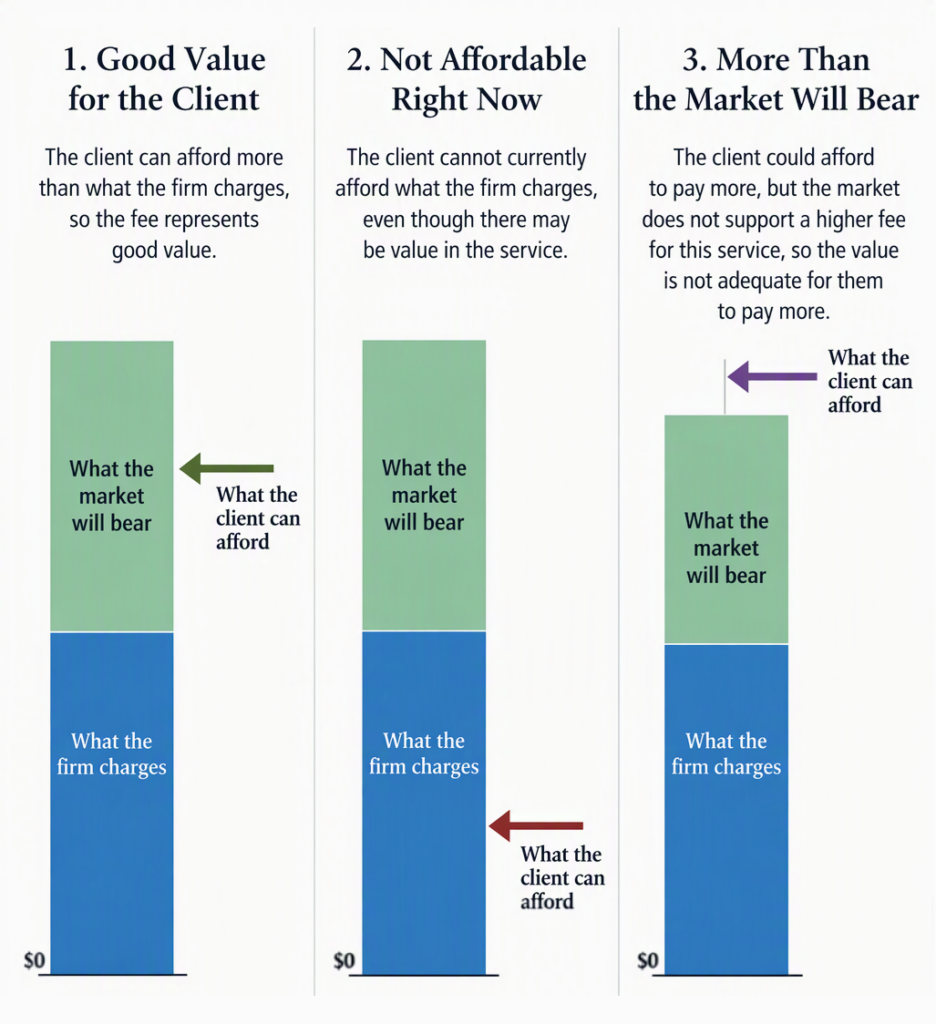
Assume for a moment that all compliance concerns are reasonably addressed in the scenarios outlined above.
In the first example, a client could afford the planning fee and even more potentially based on market forces. There would be no disproportionate harm to the client if the client of their own volition chose to tell the planner to charge them more because they valued their services so greatly, albeit the tacit acknowledgment that they might be financially better off if they didn’t opt to do so. You might call this “paying for first class.” No one needs to fly first class to get to their destination (as the old adage goes, people buy the destination, not the ticket), yet there is a demand for first class seats. You might argue that paying for first class means you get a better seat and more amenities, but here we’re arguing over semantics; someone buys the first class seat in anticipation of better value as they see it, or someone receives greater value from their financial planner than they feel they paid for and offers to true up the difference. Notably, they have no obligation to do so in the case of a financial planner, but they are opting to do so of their own free will.
In the second example, the client would like to pay more than they can afford. This is problematic and evokes the fiduciary duty to charge no more than reasonable fees to their clients. While the client might value what the planner does enough to warrant a desire to “overpay” for services, the planner has an obligation to inform the potential client that their fees exceed the value they can reasonably anticipate delivering, and should provide a referral or resources to more appropriate options.
In the third example, the client is “getting a bargain.” That is to say, they are paying far less to their firm than even what the market will bear or what their resources can afford. This is a popular value proposition among some financial planners who like to work with a higher net worth clientele while offering a limited scope of services (e.g., a client who could potentially afford and benefit from a family office type of firm, but opts to work with a more mid-market RIA). Ultimately, the client may opt to pay whatever is required by the advisory firm, and in some instances, may opt to pay more than the required amount but still within the bounds of market norms or what compliance will permit.
All Things Being Equal
Let’s presume that whatever the firm charges its clients is reasonable and whatever the client wants to pay is reasonable in the strictly regulatory and compliance sense (e.g. less than 3% for AUM, not exceeding state-limited hourly rates, etc.) In reference to the above, we’re looking at a scenario 1 or scenario 3, but not a scenario 2. At this point, the decision to pay more by the client, and the decision to accept or decline more by the planner, is purely a matter of preference. We’re not presupposing that the planner has solicited a gratuity or extra compensation from their client, but accepting the example scenario from the Kitces & Carl podcast that the client is simply so delighted with the planner and the value they receive from them that they are offering to pay more.
In terms of agency between the planner and the client, the client’s agency in offering is already being respected. They have, of their own free will, made an offer to pay more. The agency decision now rests with the planner to accept or decline the offer of additional compensation. This presents a dichotomous choice: The planner knows or otherwise believes that the offer would increase their compensation reasonably, unreasonably, or somewhere in between. If the compensation increase would be reasonable, then it’s entirely an option of preference, whatever the planner might ultimately base that upon, whether they would accept or decline the offer. If the compensation increase would be unreasonable, then the planner is ethically and potentially even legally obligated to educate the client on why such compensation would be unreasonable and should decline; and of course, if the compensation is in the ambiguous middle, then the options within the domain of reasonable apply, but it may still behoove the planner to educate the client before moving forward with accepting or declining.
Ultimately, then there’s a basic overlay to the decision. In the absence of harm the answer on the part of the planner comes down to preference. There is no objectively superior service model nor inferior compensation model; there are only good and matches thereof for the particularized needs and preferences of clients. It is not objectively bad to take extra compensation at the offer of a client if the offer is not harmful or excessive, nor is it objectively good to decline such offers on principle. The primary responsibility of the fiduciary is to provide adequate value in return for reasonable compensation, no more, no less. To say otherwise is moral cant, informed by personal values and preferences or psychological transference more than the ambiguous pursuit of objective moral reasoning. There is nothing wrong with practicing within your personal beliefs and values, nor with even expressing your beliefs and preferences to others, but to argue there is a purely rational or reasonable universal answer to such scenarios says more about the professed giver of answers than it does about the answer to the question itself.

Dr. Daniel M. Yerger is the President of MY Wealth Planners®, a fee-only financial planning firm serving Longmont, CO’s accomplished professionals.