

Not so long ago, I made the point that simplicity was its own value proposition, but simplicity is a means to an end. What does keeping money simple do for us? The answer itself is also somewhat simple: it buys us time. When you evaluate the pros and cons of a decision like how to invest your money, all options other than the lowest-effort de facto option of “do nothing” must be evaluated as a contrast in the risk but also the return net of costs. For example, two investments that ultimately yield a 10% return might be financially identical in gross value, but if one was a fund you bought one time and let sit, and the other was a rental that you had to go through sourcing, buying, insuring, upkeeping, renting out, releasing, and eventually selling, you’d reasonably infer that the fund was the lower cost option, even if it came out with the same financial result.
Why bring this up? Well, today I’m being a bit introspective. You see, this weekend will mark the 7-year anniversary of MY Wealth Planners, but this year also already marked my 11th year in practice as a financial planner. Growing up from just being a Financial Advisor for a national RIA to obtaining my CFP® Certification and Ph.D. in Personal Financial Planning, along with countless client meetings, cocktail party conversations, and a never-enough supply of late nights chatting in hotel bars with colleagues has lent me a bit of perspective. Not a particularly unique or special insight, not a functional crystal ball (much as I enjoy the non-functional one my first client gifted me years ago), but simply a perspective on the idea that buying back time is one of the most valuable things about finance. So today, I’m sharing a bit about my perspective on the topic, particularly through the lens of someone who does this for a living, for the curious.
The Best Possible Investment
Pop quiz: I have been a financial advisor since July 16th, 2015. Given the power of flawless hindsight, let me ask you two related questions.
- How many times, up to today, do you think anyone has ever asked me about investing in the best-performing investment in the world since that time?
- What is the best-performing investment in the world since I became a financial advisor?
Answer Key (Highlight the Page to See the Clear Text):
- None.
- Samsung Electronics (SSNLF) with a total return of 454,100% between 07/16/2015 and 10/20/2026.
Now if you guessed the answer, good for you. But to put it in perspective, the return of a company you probably think of as a “darn, I wish I’d gotten in earlier” type of investment, Nvidia, has only grown by 44,430% in the same time period, and that one I only started hearing about in early 2025 when it came out as one of the early winners of the AI-supporting infrastructure race.
Yet, over time I’ve fielded 1,001 conversations about everything from Bitcoin (29,180%), Gold (261.7%), to Boulder real estate (92.8%). People have told me excitedly from time to time about every investment opportunity you can imagine. I don’t blame people for being interested in the exciting asset du jour; rather, if I take any irritation or umbrage from the subject matter, it’s the wholesale dismissal some of these same folks will then address a lower-risk and more diversified asset base with. Whether it’s the stock market (which will crash any day now, apparently, in perpetuity or on any day ending in Y), the US dollar’s impending demise, or even the futility of saving in a 401(k), apparently all things mundane are bad, and only the most exciting or exotic of things are good.
Yet, when I look at less concentrated and far less speculative investments than the heated passion of Cyrptonerds or buying a fixer-upper on the Hill by CU, I am far from unimpressed at the growth of a more diverse collection of options. The annualized return of the US Stock Market as a whole has been about 13.7% since I got my start; far above the long-term average I was taught in grad school and even expect today. While an unusually hot market is certainly a blessing, I find myself pleasantly nonplussed by the results of all sorts of assets in the market. For example, compare the benchmark indices for the US Market, the price of gold, stocks outside of the US market, real estate, Treasury bills, and aggregate US bonds.
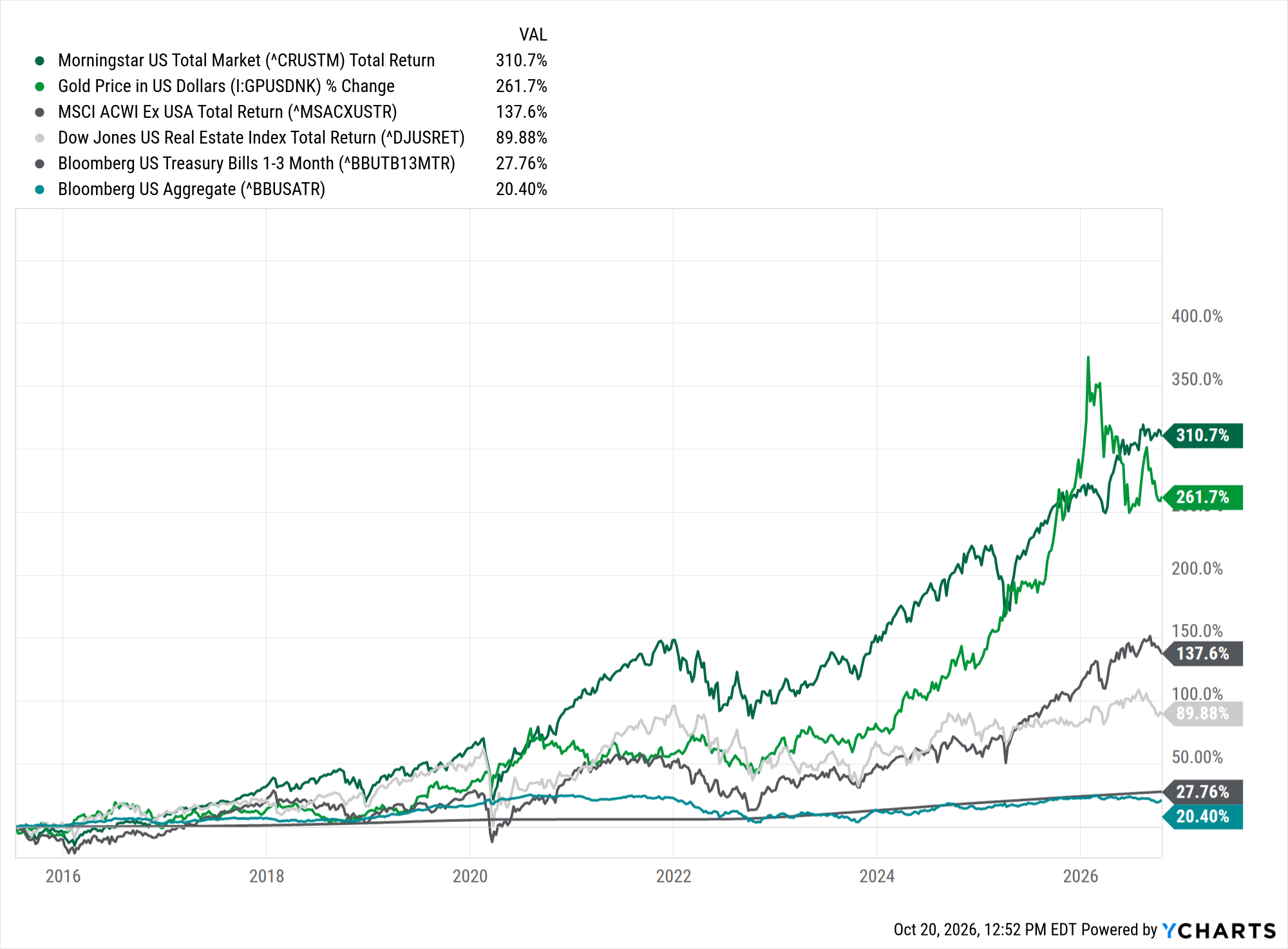
Of course, as regulators are wont to remind us, you cannot invest directly in an index. So, here are the returns of some index funds that track these indices, e.g. “returns you could have actually gotten.”
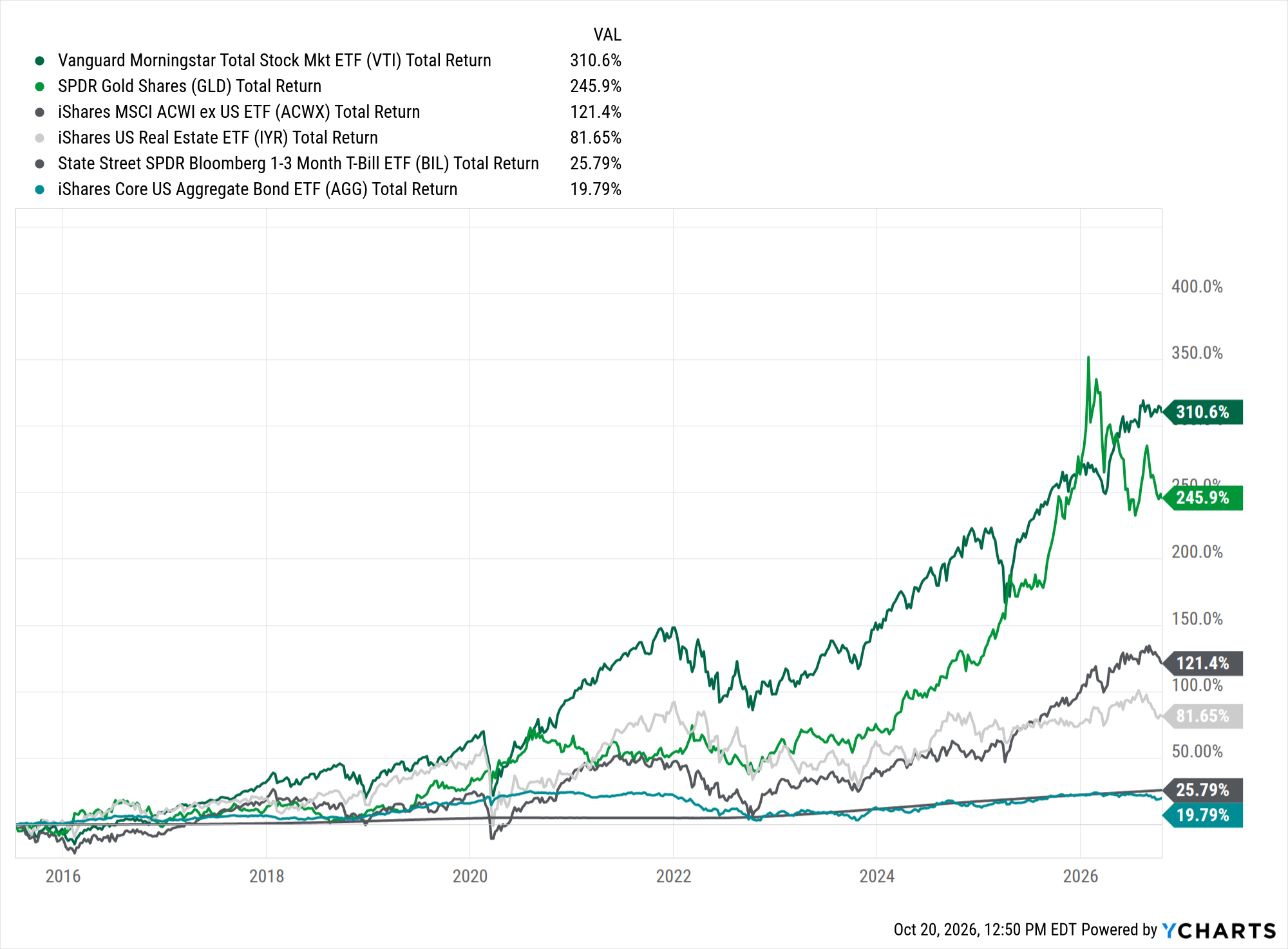
In other words, if you’d just invested in the US Stock Market since the day I became a financial advisor, you’d happily have made 310.6% to date. If you were a gold bug you’d have done a not-so-shabby 245.9%. Worried about the US economy and markets and want to invest overseas? Not a problem: a not-bad-at-all 121.4%. US Real Estate but don’t want to get your hands dirty fixing and flipping or managing properties and tenants? 81.65%. Heck, if you just stuck your money in a commonplace cash equivalent like T-Bills, you’d have at least kept 25.79% in growth, albeit a bit closer to inflation than you’d like to be.
How Much Juice Can You Squeeze From Time?
I manage money for clients as part of how I make my living as a financial planner, to no one’s surprise. This means I personally put hundreds of hours a year into monitoring markets, analyzing investments, and placing the assorted trades that ensure clients’ portfolios are appropriately and efficiently attended to. The result of this trust on the part of clients has been that, to date since the firm took on its first investment dollar on 12/12/2019, clients have entrusted us with $93,561,195 (net of distributions and withdrawals), and we’ve been able to return $35,944,556 to them to date.
Bear in mind, as I say that, that it has taken a bit shy of 7 years to do, and that plenty of clients have made more money than others or lost more money than others along the way. It’s not a performance claim on my part, just a statement of facts: $93 million-and-change invested with us, $35 million-and-change more wealth directly because I spend time managing clients’ investments. This also excludes all the assets we advise on but don’t manage, such as clients’ 401(k) plans, pensions, or equity grants that are better left where they are sometimes, rather than being handed over to our management.
That’s not to say clients couldn’t have made more money investing elsewhere, or by spending their own time doing their own investment research, or otherwise by taking on bigger risks or tighter concentrations in the right assets at the right time. In fact, we often help clients reduce costs in their portfolio, which can improve returns net of costs, but also do so as we de-risk their portfolios, reducing expected return in exchange for making the rollercoaster ride of investing a bit less bumpy.
The point I’m really trying to make in bringing this up is not “our clients have made X dollars,” but to point back to time: clients’ time commitment to obtain this return on their capital has included a handful of meetings to get to know them, gathering their financial data so we could build them a financial plan, and then otherwise meeting for largely unrelated discussions periodically to talk about more interesting things like funding gifts to family members, upcoming trips to far-off places, or the relatively mundane like reducing taxes or re-evaluating insurance and estate plans. All worthy activities, but if you’re a client of the firm today, when you think about it, when was the last time we shoved your portfolio performance under your nose in a meeting and engaged you in an excited but lengthy conversation about some new investment opportunity?
And that’s the point. Clients benefit by being invested, whether with us or externally, in diversified and low-cost assets tracking more or less aggressive returns. There are losses, there are gains, but in the aggregate, the numbers representing the value of delayed gratification on their part generally trend up and to the right. Maybe not fund by fund or asset by asset, but across the diversified and time-absent investments we recommend.
Exciting, At One Time Or Another
Investments can be exciting at one time or another. In my time as a financial advisor, some of the best-performing assets have been companies like Domino’s or Monster Energy (I didn’t buy them, mind you, but it’s a fun fact). Other times it’s been the remarkably dull short-term US Treasury (thinking about market downturns!) Yet no client’s life has ever been made that much better or worse for being overly involved in the index fund of the day, yet we’ve had plenty of tears shed at the table by clients regretting speculative bets or otherwise expressing their distress because they can’t tear their eyes away from a trading app that they’ve been day trading in.
I’ll say it again: investments can be exciting at one time or another. But through the lens of a financial planner, I tend to feel and recommend to clients accordingly that they’re better off thinking about their investments as being a type of gravity: things bounce occasionally or go in odd directions and angles, but otherwise that remains a generalized constant in their life that they don’t think about too much, except those times they’re looking into skydiving.
And that’s the point: money can be a source of pain or joy, but even as a person whose professional life revolves around money, I don’t find that people’s lives are made better by focusing on money any more or longer than it requires to be sufficiently and responsibly handled. And in all the years I’ve asked people what they’d do if money wasn’t the limiting issue in their life, no one has ever said: “look at my portfolio more often.”
Take that for what it’s worth. I certainly do.

Dr. Daniel M. Yerger is the President of MY Wealth Planners®, a fee-only financial planning firm serving Longmont, CO’s accomplished professionals.