

Free is an interesting word in the world of financial services. Free checking, commission-free trading, and free financial planning are bandied about the marketing ecosystem of financial firms all the time. Yet, there is an observation that has long been applied to platforms like Facebook and other social media: “If you’re not paying for the product, you are the product.”
It turns out that while the world of financial services does actually charge for its services, it’s generally favored an approach of “low friction” when it comes to making money. In other words, over time the financial services world has shied away from sending invoices and has instead looked to bake its revenue “into the terms.” Getting paid indirectly or in a way that doesn’t show up on your account statement, rather than showing glaring line items like “trading fee” or “account fee.” So today, I thought we’d explore a bit about how the world of financial institutions makes money “on the back end,” out of sight and out of mind, to the tune of tens of billions of dollars a year.
What You Know You Pay For
Most consumers are aware of the primary fees they pay. If you pay your financial planner on a subscription basis or your investment manager as a percentage of assets under management, you likely get a monthly or quarterly invoice detailing what your fee was, how it was calculated, and showing you when it was billed to you. Often fees are deducted from investment accounts, but sometimes people pay by bank link or credit card. Regardless of the route you go, the research is fairly clear that the majority of consumers of advisory and financial planning services know they’re paying for the services and how much they’re paying (Seay & Kim, 2018). In fact, as consumer demand and financial services regulation have steadily pushed towards fiduciary conduct and reduction or disclosure of conflicts of interest, fees for service have become more and more transparent.
Curiously, while many pundits around the financial services space have opined for decades that “if consumers knew what they were paying, they’d demand to pay less,” fee compression has actually entirely evaded personalized financial advice. In fact, even with the advent of AI tools and Roboadvisors before that, fees for personalized financial advice are actually increasing, not decreasing. In fact, even the most recent benchmarking studies for advisory firms have shown that over the past decade, fees for services in financial planning firms have generally exploded (Figure 1); even our firm, which generally charges below market rates for services to increase accessibility, has seen enormous growth in fees, rather than downward pressure (Figure 2).
Figure 1
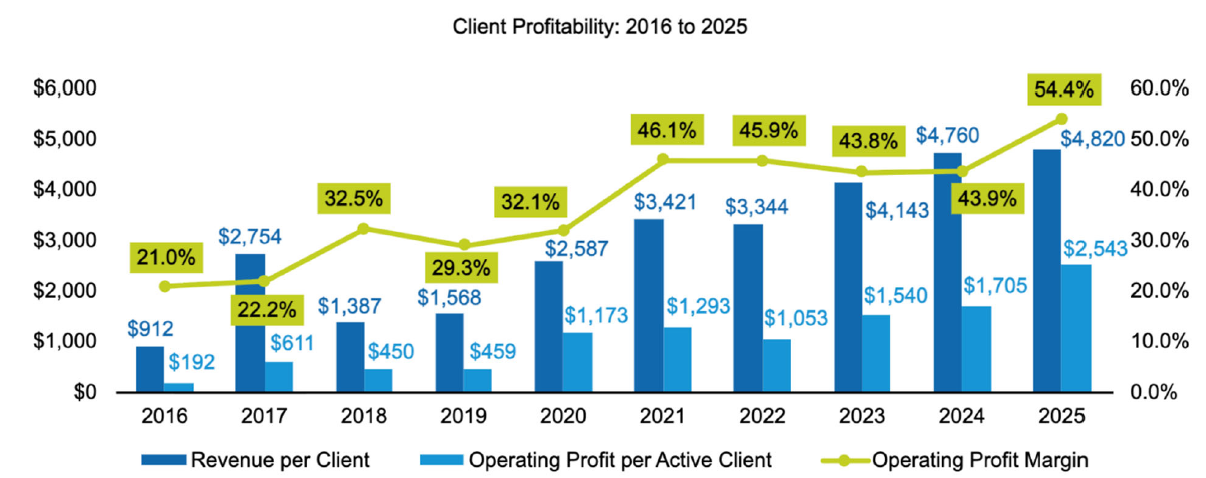
Source: XYPN Benchmarking Study 2026 showing revenue, expense, and margin per client, which is an annual cross-sectional study of fee-only financial planning firms.
Figure 2
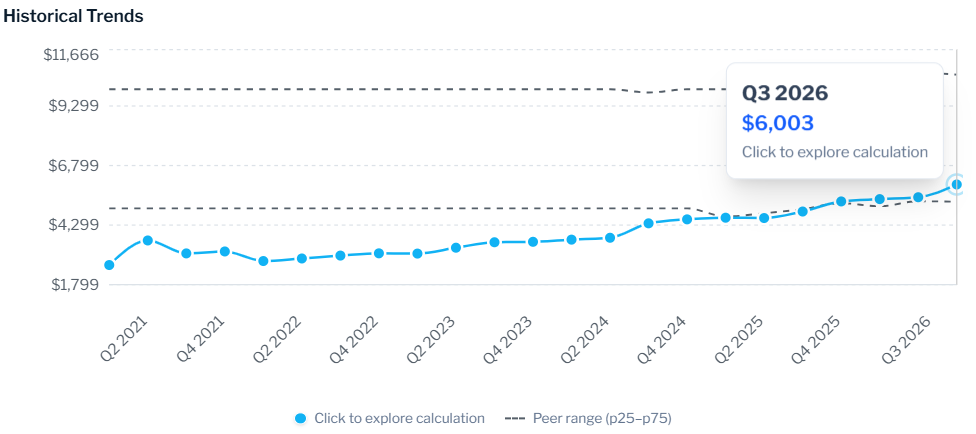
Source: AdvisorEconomics benchmarking showing revenue per client. The blue line shows MY Wealth Planners’ quarterly average revenue per client; the dashed lines show quarterly average revenue at the 25th and 75th percentiles in the Advisory Firm universe that are part of the AdvisorEconomics dataset.
So if revenue and costs for firms are increasing rather than decreasing with the addition of more automation, why the discussion of financial services’ inclination to hide or obfuscate expenses in the introduction? The key is that there is a material distinction between the financial planning services ecosystem and the product and platform institutional ecosystem. While effectively the majority of digitally-tracked wealth (i.e., checking, savings, brokerages, 401(k) plans, etc.) lives on institutional brokerage platforms, and thus represents an ever-expanding zero-sum game of affluence, the financial planning world is shrinking, not growing.
That’s not to say that there aren’t more CFP® Professionals than ever. As of the last exam cycle, the CFP Board in the United States reported 110,974 CFP® Professionals in the United States; if matched to the industry estimate that there are approximately 330,000 financial advisors in the United States, that means that CFP® Professional market share has grown to about 1 in 3 financial advice professionals. Yet, studies by Cerulli Associates and McKinsey have found that the industry will be undersupplied in financial advisors by 75,000 in 2033 or 100,000 by 2034. This is because, while there are more financial advisors joining the industry year over year, with an abundance of financial planning certification programs growing within universities, the profession’s average age is so high that the volume of retirements is almost netting out to close to net zero (<1% growth year over year), which is not keeping pace with national demand!
In turn, brokerage institutions and financial product institutions have faced fierce commoditization and competition in their products and services. Morningstar’s most recent study on investment product fees has found that over the past 20 years, the average investment fund fee has declined from 0.80% annually to 0.32% annually. The average fee of passive index funds has fallen from 0.154% to 0.10% annually, the average ETF charges half as much as the average mutual fund, and Charles Schwab and Vanguard are tied as the lowest cost providers with an average asset-weighted fee of 0.07% annually.
Figure 3.
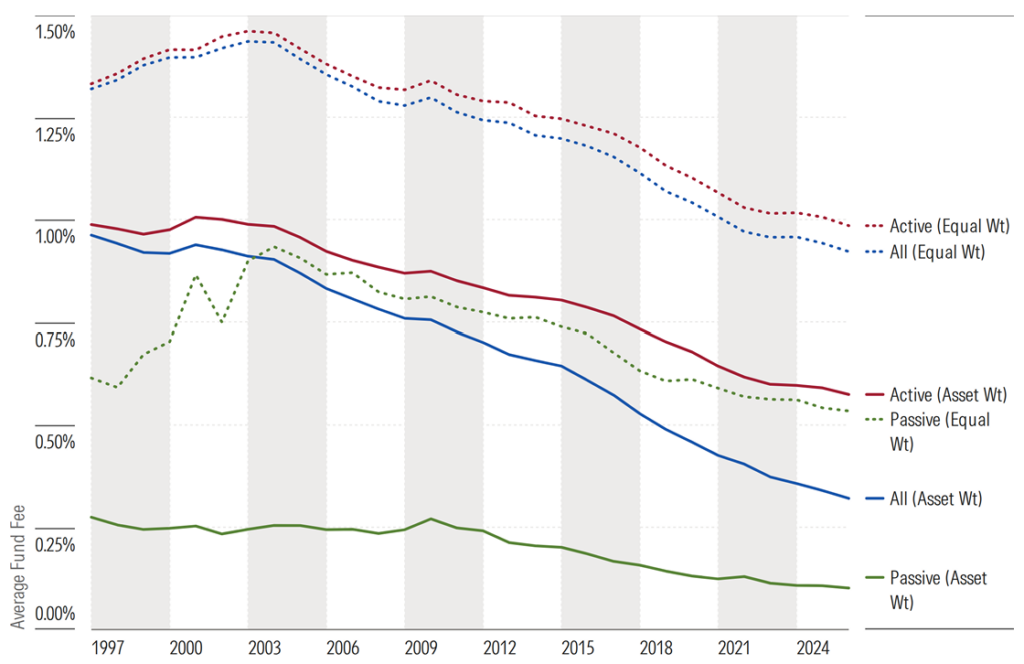
Source: Morningstar 2026 US Fund Fee Study.
But if the costs charged by some of the largest institutional platforms and product providers have declined by so much over the past several decades, how is it that revenue is up across the board? To some extent, this can be explained simply by the volume of capital passing through these products and platforms, but to a greater extent, the answer lies outside of what you’ll find on your monthly statement.
Cash Is King
It’s easy to forget, but as recently as 2019, most people buying or selling investments at an online brokerage like Vanguard, Fidelity, or Charles Schwab were paying $5.99 to do so. Six bucks isn’t a bank breaker in the grand scheme of things, but for someone saving $100 in their IRA every month, this was equivalent to a 6% sales commission every time they went to buy a stock or an ETF. Pressure was put on this business model when Robinhood came onto the scene in 2014, but in 2019, Charles Schwab effectively killed the discount brokerage commission by announcing it would do away with trading commissions. Vanguard, Fidelity, and TD Ameritrade rapidly followed suit. What then followed was the absorption of TD Ameritrade by Charles Schwab in a matter of weeks. How?
The key difference in the business model of Charles Schwab and TD Ameritrade at the time was where they made their money. While each offered investment products and services on their platform, TD Ameritrade favored making money from commissions, whereas Charles Schwab focused on the cash on its platform. At the end of 2019, Charles Schwab reported it had $4.04 trillion dollars on its platform. If even one tenth of one percent (0.1%) of the money on its platform wasn’t invested actively, that meant it had $4.04 billion dollars uninvested by its customers just lying around, waiting to be lent out to margin borrowers or even just to be kept in a treasury portfolio. Given that the US T-Bill yield at the time was 1.875%, that meant that Charles Schwab could make no less than $75.75 million risk-free; and with the kind of financial talent that being one of the largest financial institutions in the world can afford, Charles Schwab was more than poised to make more than that. They reported $6.5 billion in net interest revenue alone that year, or 61% of its total $10.7 billion in revenue for 2019.
But that bit of interesting history aside, it turns out not much has changed. Every major institutional asset platform makes hundreds of millions, if not billions, of dollars a year simply by deploying its customers’ idle cash deposits more efficiently. By paying rock-bottom interest in “literal cash” as opposed to money market funds or cash sweep options yielding more competitive rates, brokerage platforms continue to vacuum up the difference between what their customers are willing to lend to it for (e.g., typically a fraction of 1%) and what it can lend money out for (i.e., several percent in margin loans, pledged asset lines, credit cards, and mortgages). Client’s apathy about rounding out their trades, even by a few dollars at a time, amounts to billion-dollar opportunities for large institutional asset platforms!
Some clients have pushed back on this practice, with institutions such as Merrill, LPL, Ameriprise, and others finding themselves under SEC investigations and class action lawsuits in cases where their firm served as both investment platform and investment adviser, arguing that the advisers placing client money on platforms owned by the adviser’s firms and then paying little to nothing on their cash breaches their fiduciary duty to their clients. For MY Wealth Planners’ part? Well, we don’t own a brokerage or work for a brokerage, so we just try to invest every penny of client money so that nothing is being left on the table.
Payment for Order Flow
Advocates of this practice will argue that it’s the best of both worlds, but ultimately all revenue comes out of the client’s pocket. In a world where the US stock market typically trades 7-9 billion shares daily (approximately $430-$500 billion dollars in value in today’s dollars), payment for order flow is part of the “middleman” infrastructure of financial markets. You see, pricing individual stocks or bonds is actually not a very profitable venture. Sure, a bond might price up or down by as much as 1-2% when someone makes a bid or ask on buying or selling, but when bonds are priced in $1,000 increments, that means the whole trade of a single share might be only $10-$20 in revenue. Now take heavily traded stocks and ETFs like Apple stock or Vanguard’s S&P 500 Index ETF, which trade millions of shares daily, and the spread on a transaction might shrink to less than $0.01 per share. So what is payment for order flow, and where does it come from?
Well, since there’s little to no money to be made in trading single stocks or bonds in the retail market, market-making companies often offer to buy or sell popularly traded investments in enormous block sums, offering fixed or flat pricing on any given investment on a going basis. This provides liquidity to the marketplace for popular investments, but also presents an opportunity to make money in volume. Where bids and asks can only effectively be priced in real denominations (e.g., $0.01 per share) when trading at the individual stock or bond level, when you’re trading in tens of thousands or hundreds of thousands of shares at once, market makers can offer a bid or an ask rate at the sub-penny level, such that they might make as little as 11/100ths of a penny per share within a larger block trade.
Brokerage platforms and financial institutions thus compete with each other both in the retail marketplace for customers (e.g., “open your XYZ brokerage IRA today!”) but also with each other for these large block transactions, as do market makers. In order to obtain the volume they need to be profitable, market making institutions will “buy” trade volume from brokerages, which constitute a better bid or ask paid to the brokerage’s customers, but with a margin that goes to the brokerage; effectively sharing some of that sub-penny fractional value per share that ultimately is paid by the individual customers in the form of getting one penny more or less on the respective individual purchase or sale.
Pricing Your Book & Revenue Sharing
Finally, some institutions simply refuse to take a loss, and take a more active role in ensuring that they make money on every client and position on their platform. While many brokerages can be relatively agnostic about investments on their platform, only showing mild favoritism to their own products or cash options, others are outright aggressive about it.
Take Fidelity, which announced last week that it would remove any registered investment adviser on its platform managing less than $100 million by June of 2027. Previously, Fidelity had made it a practice to either charge RIAs a fee outright for being on their platform if their balance was too small, or would otherwise “price” their clients’ portfolios to see if they held enough money in Fidelity products to generate enough revenue to cover the fees.
Such practices are particularly common in the 401(k) universe; many 401(k) platform companies will offer employers a lower platform fee (e.g., directly-paid fees by the company) if they will offer more proprietary products in their fund lineup. This is why you often see that plans on Fidelity have more Fidelity funds, plans on Voya have more Voya funds, plans on T. Rowe Price have more T. Rowe Price funds, etc.
On the retail side of the house, the practice of “selling shelf space” is perfectly common. Firms like Edward Jones will sell the right to be sold to its clients to fund companies. In other words, “Pay us to sell your product, or we won’t let our customers buy your product.” Seems like a double-ended deal, and when you see that it totals as much as $332 million dollars a year, you might get the idea that it’s a big part of a financial institution’s business to sell access to clients’ investment portfolios.*
*For scale, that’s approximately $16,600 in revenue per financial advisor at Edward Jones in 2025, just for the privilege of being sold to their clients, who then pay their own fees and commissions!
Can You Avoid It?
Simply put, no. Not really. While it’s not ideal to realize that the financial institutional world has invented such an array of money-making mechanisms that it would make the innkeeper in Les Misérables jealous, these costs are, net of what they buy, probably worth the cost of doing business. While it’s not ideal to lose out of billions of dollars in net interest by being invested in sub-par cash options, to take a microscopic haircut every time you buy or sell investments, or to realize that you only have a catalog to invest from that is essentially made of paid advertisements from your broker, evaluate the alternative: go find individuals with hard copy investments and trade them actual cash for their shares, or find buyers for your shares willing to transact in-kind or in a similar medium.
When you break it down to the baseline, financial institutions are businesses. WSJ writer and author Andy Kessler describes the entire world of finance as “greasers”: institutions and professionals who do not make or create, build or produce, but rather, whose services and products reduce friction between otherwise separate parties (e.g., depositors and borrowers) in order to expedite the flow of capital around the world. The entire service of doing so, broadly speaking, lends itself to a business made in fractions of fractions. It’s the plot of “Office Space” but with less sarcastic Gen-X amusement and more of an official business model.
So, while we’d all happily pay less for the services we receive or the products we use, it must be worth acknowledging that the costs are better than the alternatives.

Dr. Daniel M. Yerger is the President of MY Wealth Planners®, a fee-only financial planning firm serving Longmont, CO’s accomplished professionals.