

Every year when tax measures are on the ballot, we take some time to parse the potential financial impact of such measures on our clients. We don’t opine on political candidates or measures, nor do we tell you what you “should” vote for. We simply aim to provide more financial context where relevant, and to help our clients measure the pros and cons of the votable issues of the day.
Amendment 87 – Graduated Income Tax
Amendment 87 proposes to replace the existing constitutional requirement that the state income tax rate be set at a single flat rate, and replaces it with a progressive tax structure, along with permitting the state to keep any additional revenue generated by the new tax structure above the limits of the Taxpayer Bill of Rights (“TABOR”). The proposed brackets are as follows:
| Taxable Income Bracket | Proposed Rate | Increase or Decrease from Current Tax Rate |
| $25,000 or less | 3.7% | -0.7% |
| $25,001 to $100,000 | 4.2% | -0.2% |
| $100,001 to $500,000 | 4.4% | No Change |
| $500,001 to $750,000 | 7.4% | +3.0% |
| $750,001 to $1,000,000 | 7.9% | +3.5% |
| More than $1,000,000 | 8.4% | +4.0% |
In effect, for every $1,000 of income, the current and proposed tax levels look like this:
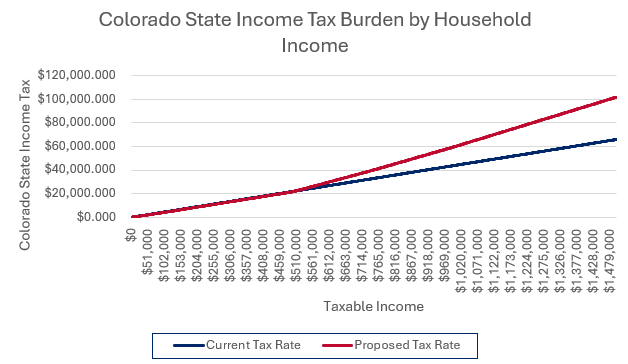
In reviewing the chart, you could be forgiven for thinking that there’s essentially no difference up to the point of $500,000 in income, and then a sudden and dramatic pull-away. And that’s true. An easier comparison might be the net difference in tax burden.
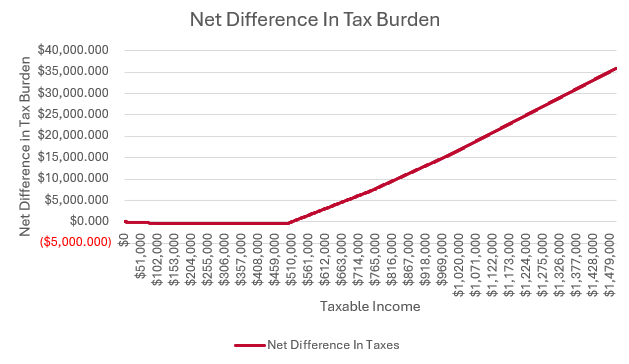
Effectively, those earning up to $500,000 will see their state income taxes reduced by a maximum of $325 net of their current tax liability. Those earning more than $511,000 annually will see their taxes increase by a significantly larger amount.
We won’t argue whether nominal savings for many below the $511,000 income level is worthy of the substantial increase in taxes on those earning above that level, but will instead draw your attention to a few material items of consideration:
- The current flat-tax system of income tax in Colorado is classified as “regressive” in policy terms because it places an equally calculated tax burden on all taxpayers. However, an equally proportioned burden does fall more heavily upon lower-income taxpayers because they have a lesser proportion of their income available to pay for basic necessities.
- Colorado already has a standard tax deduction cliff for those earning more than $400,000, where the standard deduction is reduced to $0. This is a result of past ballot measures (Proposition FF and later House Bill 21-1311) to fund school lunches.
- Like the prior ballot measure, this proposal for the constitutional amendment does not include any adjustments for household composition or inflation. This means that married households are more likely to end up with higher taxes than single tax filers, but also that as inflation increases earned income while reducing purchasing power, more and more taxpayers will end up with higher tax rates.
In the aggregate, it is estimated that this measure will generate $2.6 billion dollars in new tax revenue to the State of Colorado; keep in mind that’s net of the up to $325 decline in taxes for those earning less than $511,000 annually as a household, so it is anticipated that the vast majority of this tax will be collected from larger employers in the state, which could have ramifications downstream of the tax measure in terms of whether larger primary employer companies maintain or start operations within the state.
Proposition NN – Keep and Spend Money for Education and Other Purposes
Proposition NN on the Colorado ballot aims to resolve an ongoing budgetary issue that occurs effectively every year. Because Colorado has a sweeping system of income tax, property taxes, sales taxes, and “non-tax” fees that are paid into both the general fund and specific sub-funds for assorted public programs, Colorado generates a genuinely enormous amount of government funding revenue. However, Colorado has TABOR, which caps the annual tax-based revenue* the state can take in every year, and requires the state to refund excess taxes taken in.
*Note that we are being specific about tax-based revenue, because the fees the state takes in are uncapped in their entirety. For reference, various studies have calculated that anywhere from 50%-77% of total state spending in a given year is funded by fees rather than tax revenue. In other words, the state brings in between 2x and 4x as much revenue from fees as taxes.
The proposal under NN is ostensibly to permit the state to keep the excess tax revenue generated above the limits of TABOR, with the requirement that for the first ten years of the tax measure, the excess revenue be spent on K-12 education. It is noteworthy then that the measure’s permission to retain excess revenue above TABOR continues past the ten-year mark. In other words, while the bill is called “Keep and spend money for education and other purposes,” it would more accurately be called the “End TABOR” act.
Whether you believe TABOR places a fair limitation on the ability of the Colorado state government to collect taxes from the public or not, this measure does not explicitly raise your tax burden; it only defrays your tax burden insofar as you pay your tax liabilities every year and under TABOR might then qualify for a refund of some of those liabilities. Voting for the measure essentially ensures the state will be able to collect uncapped tax revenue going forward and assigns that revenue to education for the next decade; voting against the measure limits revenue going to education over the next decade but protects the taxpayer against taxation in excess of the state’s legally permitted needs.
Proposition 136 – Income Tax Rate Limit
The inverse proposal to Amendment 87, Proposition 136 creates a statutory maximum income tax of 4.4% (the current tax rate) in Colorado. It does not increase or decrease taxes whatsoever, only require that Colorado cannot raise taxes higher than 4.4%. To that extent then, it is perhaps more a symbolic measure, since like any other law, a future ballot measure could aim to remove Proposition 136 and install another tax rate that is not already currently in effect.
Voting for the measure is effectively symbolic that you are satisfied with the current level of income tax in Colorado. Voting against the measure might mean you’re more in favor of the graduated income tax proposed under Amendment 87 or otherwise are disinterested in the symbolic nature of the measure.
Special Note – Amendment 87 & Proposition 136
Being the astute reader that you are, you’ve probably already asked yourself this question by now: What happens if Amendment 87 and Proposition 136 pass? Well, two items address this. First, Amendment 87 has language in it that nullifies other income tax-related measures that could otherwise affect the graduated brackets it proposes. Second, as a constitutional measure, it is likely that even in the absence of such nullifying language, a constitutional amendment would supersede an underlying statutory limit, and consequently the Colorado Supreme Court would likely have to find Proposition 136 unconstitutional or otherwise rendered moot by the superseding power of the state constitution.
Thus, there is a “combined outcome” where you could vote in Amendment 87 to lower taxes for those earning less than $511,000 while also capping the tax increases at 4.4%, thus rendering the combined effect to be lower taxes but the same maximum income tax. The only applicable results are:
- Amendment 87 Passes, Proposition 136 Passes: The graduated income tax takes effect, and there is no income tax cap.
- Amendment 87 Passes, Proposition 136 Does Not Pass: The graduated income tax takes effect, and there is no income tax cap.
- Amendment 87 Does Not Pass, Proposition 136 Does Pass: Colorado has a statutorily limited income tax of 4.4%.
- Neither Amendment 87 nor Proposition 136 Passes: Colorado continues to have a 4.4% income tax.
Boulder County Issue 1A – Early Childhood Care and Education Mill Levy Increase and Voter-Approved Revenue Change
A measure proposing to install a 2.579 mill levy property tax, with the expectation of generating $30 million in 2027. A mill generally equates to $1 of property tax per $1,000 of property value. Thus, for a home assessed as being worth $500,000, you would anticipate a $500 property tax increase. However, because of prior legislation, including the Gallagher Amendment, Colorado must discount the amount of property tax revenue generated by residential properties as opposed to industrial, commercial, and agricultural properties, which must be taxed approximately 2.5x more as a source of revenue than residential properties.
Thus, you can anticipate that the tax impact on residential property of a similar value is likely to be closer to $100, whereas the impact on a similarly valued commercial property might end up being closer to the original estimate. Bear in mind that businesses pass costs through to their customers, so it may strike you as somewhat pedantic to measure the distinction between residential and commercial property. However, not all businesses are immune to market forces; while you might happily pay a premium to shop and support a local business, your financial resources are finite, and consequently, if prices increase too much at any given business, you might find that you turn to other cheaper or online options.
So, what is the tax going to pay for? Simple: Subsidizing childcare. The ballot proposes to allocate the $30 million and future revenues to subsidize childcare facilities, including operating costs and expenses, providing administrative support for such providers, and also providing funding for the administrative role an appointed organization will oversee. With childcare easily exceeding $20,000 per child in Boulder County, this is seen as a major issue in the affordability of the area; particularly when over 1,000 children in Boulder County are currently unable to be served based on availability and costs.
Ultimately, the primary beneficiaries of this measure will be low- and middle-income families with young children in Boulder County. Whether you personally benefit or feel it is of distinct importance that the county help with such costs is likely a determinant of your desire to vote or not vote for the measure.
City of Boulder Ballot Issue 2J – Residential Vacancy Excise Tax
Similar to New York City’s well-publicized pied-à-terre tax earlier this year, this measure adds a $4,000 property tax to any residential property that is not occupied for at least 183 days out of the year (e.g., 50.1% vacancy), with the aim of forcing homeowners and owners of multiple properties to rent out existing properties or otherwise make more effective use of the property. This aims largely at increasing the supply of residential property in the county available for purchase or rent. The revenues collected for the measure will go to support general City of Boulder services. This is the type of measure you vote for if you’re inclined to force use of private property for a public good or vote against on the principle that property owners shouldn’t be financially penalized if they aren’t using an asset the way the public would prefer.
City of Boulder Ballot Issue 2K – Recreation and Safety Bond
This bond issue would permit the City of Boulder to borrow up to $400 million through a general obligation bond in order to fund updates to several public facilities in the City of Boulder. Notably, most general obligation bonds do not come with explicit tax funding. However, this measure includes permission for the city to allocate an additional $32.5 million annually in property tax to properties in the City of Boulder to make interest and future principal payments on the bond measure. The average homeowner of a million-dollar residence in Boulder would be anticipated to pay an additional $400 in property tax annually.
The city facilities to be updated or improved include:
- South Boulder Recreation Center, with specific inclusion of a new lap pool.
- North Boulder Recreation Center, including aquatics amenities and space for the West Age Well Senior Center to be built out.
- Fire Stations Numbers 1 & 5.
- A new Public Safety Building for Police and 911 services.
- Penfield Tate II Municipal Building.
- Municipal Services Center.
City of Lafayette Ballot Issue 2A – Extension of an Expiring Tax for Lamont Does Park
This measure extends the existing property tax passed in 2014 to fund Lamont Does Park and the related facilities from 2026 through 2046. The tax measure in place generates approximately $713,000 annually for this purpose, and is anticipated to generate similar revenues going forward. Generally speaking, a vote for the measure continues tax costs as they are, while a vote against the measure or otherwise failing to pass the measure will mean the city can only fund facility maintenance and upkeep from the general fund for the City of Lafayette.
City of Longmont Ballot Issue 3A – Maintain and Increase Fire and Police Services via Tax Increases
Of the locality-based tax measures, this one is perhaps the most contentious that I’ve seen in a while. For reference, the City of Longmont today has a 0.58% sales tax that goes to fund public safety (both police and fire services); this is in addition to funding that comes from the city’s general fund, and the budget for the Longmont Department of Public Safety has made up between 12%-17% of the City of Longmont’s gross budget annually over the past 20 years.
The original sales tax was passed in 2004 with full implementation in 2006. A second sales tax was passed in 2016 with full implementation in 2018. To date, the Department of Public Safety’s budget has increased by a total of 101.84% since the passage of the original sales tax measure, while inflation has measured 47.7% in the same time frame. The population of Longmont has grown by approximately 20% in the same time, while the per-capita crime rate has declined by approximately 16%. You might reasonably infer then that the Department of Public Safety is substantially better funded net of inflation, population growth, and crime rate, but we should keep in mind that public safety has also been handed several unfunded mandates such as greater public transparency obligations, police body cameras, etc.
Ultimately, the measure proposed this year is controversial both in light of the historic growth of the department’s funding for public safety, but also because it splits funding between both a sales tax and a property tax. The proposed 0.33% sales tax alone increases public safety funding by 56.89%, but it is combined with a proposed 2.44% mill levy on property taxes, equivalent to about $100 for a $500,000 home, with the same aforementioned ratio issues for residential and commercial properties. In other words, while your bill at the store will go up by 0.33% alone in sales tax, you should keep in mind that, as with the earlier mention of cost pass-throughs by businesses, you’re likely to see a jump in the cost of goods and services as well, which then feeds back into increasing the denominator upon which the numerator of sales tax is calculated. In effect, the bill proposes to double the budget for the Department of Public Safety in Longmont, despite already being over-funded relative to historic funding levels, at a pace greater than both population growth and the crime rate thereof.
That said, the proposal does explicitly aim to address several funding issues presently identified by the Department of Public Safety, including adding 43 police positions, 31 fire positions, and 12 collaborative services positions. It also goes to fund a new fire station and is otherwise required to be spent on the needs of the Department of Public Safety to increase its service bandwidth to address calls for service in a timelier and more efficient manner.
City of Louisville Ballot Issue 2B – Historic Preservation Tax
This measure extends the existing 0.125% sales tax passed in 2019 to fund historic preservation work in the City of Louisville through 2038. The tax measure in place generates approximately $1.5 million annually for this purpose. The measure also explicitly directs that the annual allocation from the tax that is paid to the Louisville Museum Campus should increase from 20% to 30% of the revenue collected. Voting for the measure continues existing tax funding for historic preservation, while voting against the measure will lapse this funding after 2028.
Town of Erie Ballot Issue 3E – Authorization for a new town lodging tax for purposes of paying for park and recreational facilities, capital infrastructure, law enforcement/safety and security, and for other governmental purposes
This measure creates a new 3.5% lodging tax on short-term accommodations, including hotels and motels, bed-and-breakfasts, and short-term rentals. This is effectively a sales tax on those purchasing lodging in the Town of Erie. While the measure states it will be used for the features in its title, it’s noteworthy that the measure does not require it, and that the funding will go into the Town of Erie’s general fund. That said, such tax measures are common in tourist towns and resort-heavy cities, and it is typical to see such destinations spend a decent portion of their general funds on beautification to incentivize such visits.
Special Note – Municipality of Niwot
For those unaware, while we have always had something we’ve called the “town of Niwot,” Niwot is actually an unincorporated collection of properties in the general space of Boulder County. As an unincorporated entity, everything from its streets to its traffic lights is subject to maintenance, upkeep, and oversight at the Boulder County level rather than being managed by the town itself. The slurry of tax measures that follows aims to establish the taxation and authority for the incorporation of the township itself to control and fund operations on its own. That said, all of these measures are dependent upon the township voting itself into incorporation. Since these measures are all somewhat duplicative, we’ll be a bit more succinct here.
Proposed Municipality of Niwot Ballot Issue 303 – Authorization to Levy a Property Tax
Establishes a 4 Mill Levy to fund general operations within the township. As noted with other mill levy measures, it is anticipated that a $500,000 property in Niwot would incur an estimated $200 annual property tax bill in addition to taxes already paid at the county level.
Proposed Municipality of Niwot Ballot Issue 304 – Authorization to Levy a Marijuana Special Sales Tax
This ballot issue establishes a 3% sales tax on recreational marijuana sales within Niwot, and is anticipated to generate up to $60,000 in its first year. This brings it into alignment with Longmont, which also has a 3% sales tax on recreational marijuana, and a bit below the City of Boulder which sits at 3.5%.
Proposed Municipality of Niwot Ballot Issue 305 – Authorization to Retain and Spend All Revenues
This measure permits the proposed Municipality to keep and direct the money it raises from sales and property taxes, but also includes an exemption from TABOR limits. That last part is only significant insofar as it aligns with how most municipalities in the state have exempted themselves from TABOR limits, which are typically only measured at the state level as a going concern.
Proposed Municipality of Niwot Ballot Issue 306 – Authorization to Increase Debt
This ballot issue authorizes the proposed Niwot municipality to borrow up to $15 million, with a maximum repayment cost of $28 million, to repair and improve streets, roads, bridges, drainage, sidewalks, and related transportation infrastructure. The debt would be repaid from sales and use tax revenues if the separate sales and use tax measures are approved.

Dr. Daniel M. Yerger is the President of MY Wealth Planners®, a fee-only financial planning firm serving Longmont, CO’s accomplished professionals.