

As financial planners, we’re often in the position to review the finances of clients as they are when they come to work with us, and we’re privileged to see how their finances change over time. Some are happily growing their wealth, while others come to us with the goal of decreasing their wealth and increasing their return on life. Priorities vary, but the practice of financial planning enjoys both the warm and collegial relationship between client and trusted advisor, and the work of analysis and relatively objective judgment is paramount to that relationship. In some cases, we’re also asked to evaluate or offer an opinion on more than just personal finances, such as businesses. Consulting, general contracting, and post-retirement “fun work” are common enough business subjects, but we’ve also had the opportunity to advise on everything from medical clinics to tech startups.
Today, I thought we’d mark the week of MY Wealth Planners’ founding practice’s 11th birthday by doing a bit of a retrospective. Not the same as my personal shares like the path from negative net worth to being a millionaire or the same forward-looking “state of the unions” we often perform, but more of a case study in how we might look at some of the primary issues and functions within any business we advise for any business owner we work with, and what that says about our own firm, the work we’ve done to date, and the work that may yet be ahead.
Summarizing Our Business
Here are a couple of key metrics to know about and keep in mind:
- Today we serve 201 client households.
- There are four full-time staff members in the practice: A lead planner, two analysts (also recognized as paraplanners in industry terms), and an office manager.
- Annualized recurring revenue sits around $1.15 million, which can vary month to month based on a variety of factors.
- Annualized expenses sit around $870,000, which can also vary month to month based on a variety of factors.
We have a primary business model offering with a few secondary offerings and a handful of legacy cases:
- Our primary business model is the offering of comprehensive ongoing financial planning and wealth management, including sub-categories ranging from tax planning to investment management and into exotic areas like multi-generational trust planning and divorce financial analysis. We offer this on the basis of a 0.50% of net worth annual fee, billed in monthly increments in arrears. Today, the minimum fee for this service is $6,000 annually, which is billed in $500 monthly increments.
- Our two main secondary business models are:
- An investment-only relationship is applied to cases that range from small accounts, such as those within a larger SIMPLE IRA plan for a small business, to larger balance cases, such as managing the endowment for a non-profit organization. We charge a million-plus-asset-under-management industry-benchmark 1% annually for this service, but we generally reserve it only for cases where comprehensive wealth management is not the appropriate solution for a client’s needs.
- Advising and serving as a 3(38) Fiduciary to 401(k) plans and other high-touch company retirement plans, for which we assist in advising on the plan structure and setup, ongoing due diligence on 3rd party vendors, ongoing investment analysis and model portfolio management, and otherwise offer participant financial counseling (e.g., Q&A for personal financial questions without extending to the full scope of a financial planning engagement.)
- We then have a small number of legacy client cases that make up less than 10% of our practice and still operate under a legacy service model from earlier in the practice, where financial planning was offered as a standalone service with an investment management add-on. For those households within this category, there are a few paying the legacy planning-only fee rate of 0.25% of net worth annually and who otherwise self-manage their investments, or who pay their planning fee and investment management fees separately under that legacy model (e.g. 0.25% of net worth for planning, 1% of assets under management for investments); it’s noteworthy then that the self-managing clients in this group also pay significant fees as measured by dollars relative to our firm’s average, and that we can count those specific cases on one hand; in other words, despite the legacy pricing or scope of engagement, these are not small clients or low touch relationships. And in the cases where clients are on the legacy 0.25%+1% combined fee schedule, we’ve only permitted that insofar as the math on paying a quarter of a percent of net worth and 1% of the investment assets has netted out in their favor, and have steadily graduated clients to the current primary service model as their situation has evolved to the point that the new model’s fees for such are priced better in their favor.
Finally, and relevant to our discussion later on, we recently recognized that we have three effective tranches of clients:
- Tier A clients who currently pay more than the firm’s current minimum fee. These can be comprehensive wealth management clients, investment-only clients, ERISA retirement plan clients, or any variety of clients. The sole criterion is that they pay equal to or more than our present minimum.
- Tier B clients who engage in comprehensive planning and investment management services, but came to us when the firm’s minimum was lower than it is today, and whose net worth has not adjusted such that it would be reasonable to bring them up to the current minimum fee, or that would otherwise make such a sudden increase an unreasonable cost relative to their circumstances and means. Bear in mind that over the past six years, the firm’s minimum fee has risen fivefold from $1,200 annually to $6,000, so this is not a remark on the households below the present minimum, but a recognition that forcing them up to 500% in fees in a six-year period wouldn’t be ethical on our part.
- Tier C clients, who are largely, though not entirely, smaller investment-only relationships. These are frequently the adult children of Tier A clients whom we’ve stepped in to provide assistance with investments, or in other cases are participants in small business retirement plans like a SIMPLE IRA, where the plan itself in the aggregate would meet our minimum but the individual participants might not; you could argue that they should all be lumped together as one client, but that’s not how our regulations tell us to define client, so even the new employee for a small business who has made a $100 contribution to their SIMPLE IRA is considered a client.
With over a thousand words in “context” shared, let’s get into discussing some of the main business issues we see in the practice today, and discuss the questions and the advice we might want to render to an identical practice.
Real Estate Relative to Growth
One of the most significant, if somewhat temporary, obstacles that we face as a practice is the cost of real estate (Rent + NNN). For reference, presently, 12.3% of annual revenue goes to pay for our office space today, and we pay more in triple-net than we do in rent itself. This includes both Suite 300, which clients will be familiar with, and Suite 201, which was acquired earlier this year for practical purposes to be discussed momentarily. Prior to the acquisition of Suite 201, real estate made up approximately 6%-7% of revenue in present terms. Since taking up occupancy in Suite 300 in 2023, real estate costs have shrunk from an initial 10.7% of revenue down to that 6-7% figure as revenue grew and then jumped up with the expansion to Suite 201 to 12.3%. To add icing to the real estate cost cake? We’re also saving $120,000 annually towards additional real estate, but we’ll explain that in a moment.
The primary reason for expanding into Suite 201 was to serve both a present and a future purpose. The present purpose was to open up a proximity office to one of our strongest business partners, Brewer Miller Law LLC (“Brewer Miller”, and recently Brewer Law LLC). Brewer Miller is, as Dr. Brewer puts it, “big law firm lawyers enjoying a lifestyle-sized practice.” With a team of professional alumni of some of the top real estate, business, estate, and international law firms, Brewer Miller is a powerhouse firm suited to the needs of clients with serious business and asset management legal advice. With offices already here in Longmont and a satellite location in Winter Park, Florida, they’ve provided us and, more importantly, our clients with literal world-class legal services on matters from real estate to multi-generational business and estate matters. In the present sense, with dozens of relationships shared between MY Wealth Planners and BML, it has made all the sense for us to bring their Longmont team “en suite” to be closer to us and more readily available to work with mutual clients.
The future reason for expanding into Suite 201 is simply a matter of practicality. The leases at 720 100 Year Party Court (yes, that’s really the address for those who don’t know) tend to be long, and Suite 201 came open for lease for the first time since the building was built back in 2016. Given that a new neighbor might occupy that space for the next decade, that would force the future of MY Wealth Planners into the difficult choice of “squeezing into” Suite 300 for the long-term or otherwise having to relocate rather than grow in place in the future. So, with an acknowledgment that the space in Suite 201 that is not committed to Brewer Miller is a bit of a luxury today rather than a necessity, we negotiated a lease to take over the space earlier this year and have occupied it accordingly. To its credit, the space is beautiful.




However, spending 12.3% of a firm’s revenue on rent, particularly when we’re not actively and frequently using half of it, is a bit of a business problem. Add on that we’re still saving an additional $120,000 annually towards real estate (we’ll get there imminently, I promise), and compared to industry norms of 4%-7% annual spend on real estate, we’re grossly up to our eyeballs in real estate! So what’s the deal?
Well, simply put, we want to have a permanent home. While we were originally blessed with an incredible location in Downtown Longmont at 402 Main Street, we outgrew that space and couldn’t find something comparable in the downtown area that could balance our present and future needs. Today, we can easily grow into Suite 300’s capacity and well into Suite 201’s capacity over the next decade, but at some point, we’ll really need space to expand into when the team isn’t just four people, but is eight, then sixteen, then thirty-two, and so on. With that in mind, we aim to purchase a long-term home sometime in the next 3-5 years, pending the right conditions and opportunity. In other words, we’ve guaranteed we won’t outgrow our current space short term, but we’re ever mindful that we need a permanent home sooner or later!
But why is this a business problem? Well, other than “overspending” on real estate to the tune of 4x-7x the amount that’s advisable for a financial advisory firm like ours, it also means that we’ve not been able to reinvest in other areas. If we were satisfied with being solely in Suite 300 and had no desire to grow the real estate footprint or otherwise to accrue capital to purchase a property at some point in the future, then that $180,000-$200,000 could otherwise be spent on additional talent, such as a marketing specialist, administrative support, or even bringing a third financial planning analyst online. Such as it is, such options are not presently feasible.
So, what would you advise? For us, the present course is simple: outgrow the cost ratio of real estate. We’ve grown annually year over year as a firm at a rate of about 27.74%, acknowledging that baked into that is a half-year growth for 2026 YTD of 16.5%, which will almost certainly increase by year’s end and consequently raise the average to something closer to 30% over the past five years by this year’s end. A firm growing at 30% annually will double its revenue every 2.4 years, which we’ve certainly seen to be the case. For reference, our revenue 2.4 years ago was about $515k, and today we’re at $1.15mm, which is slightly greater than double. And for the curious, here’s how our revenue run rate growth and revenue per team member have looked quarter over quarter for the past five years; notably, the growth rate has slowed a bit over the past two years which is unsurprising as the denominator of the firm’s existing size gets bigger, but you can also see that our revenue per team member otherwise tends to trend upward quarter over quarter, with major spikes or drops reflecting new hires or departures from the team, affecting the denominator of headcount more than the underlying revenue.
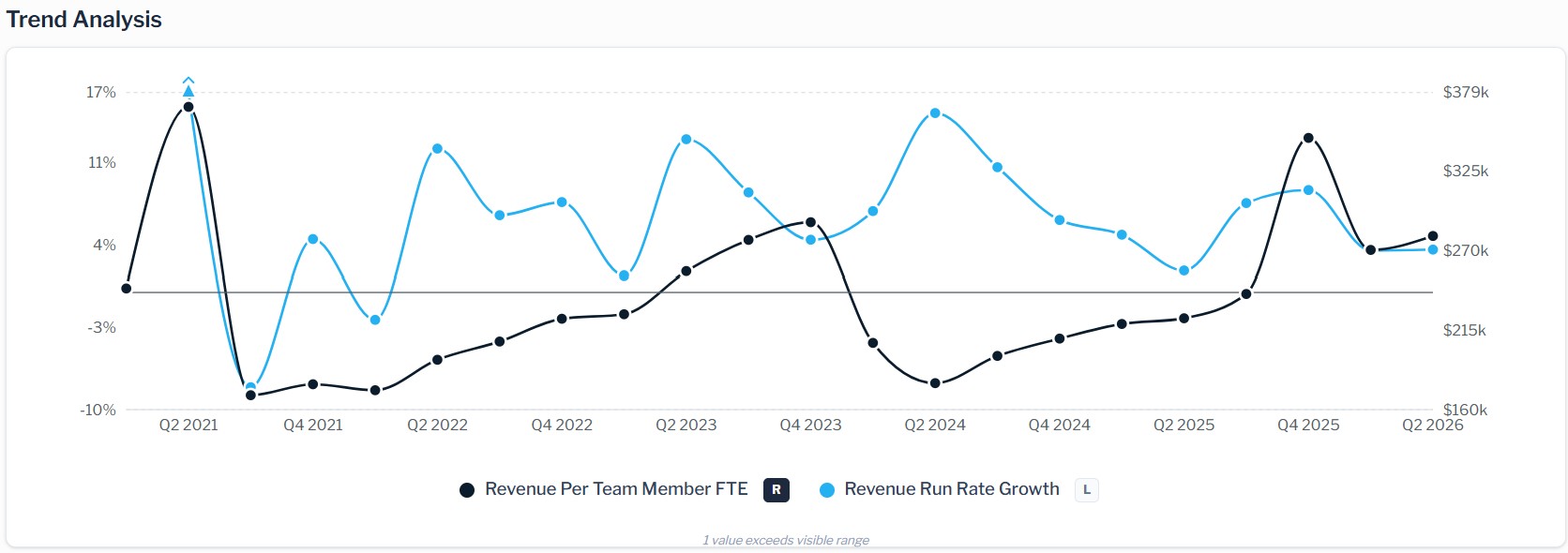
The chart above comes from a software called Advisor Economics, which uses firms’ data and financials to generate long-term and short-term financial analytics and data insight. Note that the revenue run rate growth shown in the chart above is quarterly, not annualized, though an annual view is available with lower granularity. The software is awesome, and no, we’re not sponsored to say that, it’s just awesome.
All of that data to say that if we maintain such a growth rate as doubling every 2.4 years, or even if we grow half as fast, such as doubling again in 4.8 years, then the real estate ratio will shrink from 12.3% to a more manageable and benchmark-appropriate 6.15% in 2-5 years, and we’ll have saved $360,000-$720,000 towards a long-term home in tandem.
Per Client Revenue & Expenses
With the question of real estate providing a backdrop as the largest firm expense outside of staff wages and benefits, we then take a look at a fundamental question: Is every client relationship profitable? Well, that depends. There’s an old business maxim: “If you’re losing money on every transaction, you can’t make up a margin in volume.” While companies like Walmart make their profit on pennies per product sold and thus make their money from volume, financial planning is not a volume business. In fact, some studies in the field have shown that it’s the antithesis of a volume business, with firms effectively hitting a threshold effect* as they begin to exceed a ratio of 50 clients per advisor that starts to kick in substantially when the firm exceeds a ratio of 100 clients per advisor.
*The threshold effect is a term in economics that reflects the inflection point where supply and demand begin to bend around a particular datapoint, e.g., when demand is less than X the prices are stable and low, and when the demand is greater than X the prices begin to increase exponentially.
Well, today we serve 201 client households with one lead planner and two supporting analysts. So how does that play out in the economics of the firm? Well, let’s take a look.
|
A Tier Clients |
A+B Tier Clients |
All Clients |
|
| Revenue Run Rate Per Client |
$ 12,969 |
$ 8,897 |
$ 5,565 |
|
Expense Run Rate Per Client |
$ 12,608 | $ 6,920 | $ 4,328 |
|
Expense Run Rate + Real Estate Saving Per Client |
$ 14,347 | $ 11,250 |
$ 4,925 |
What this table explains is that when we divide annualized recurring revenue and the annual real estate savings goal articulated earlier by the number of Tier A clients, by Tier A & B clients, and by all client households, a very different picture begins to emerge. Keep in mind, as we go into this discussion, that today our minimum fee is $6,000 annually.
The data indicates that, if the firm suddenly served only clients paying equal to or greater than its minimum fee, the average client would pay $12,969.30, and it would cost $12,608.70 to serve them. In other words, if we take revenue and subtract necessary expenses, there’s a profit margin of $360.60 per client household, or 2.78%. Not ideal! But worse, if the firm aims to grow with the goal of real estate savings included, it actually cannot afford that savings goal because the additional $120,000 annually of savings costs more than the average revenue of just the Tier A clients.
So, when we evaluate the same business question in light of the A + B Tier clients, we see that once again the firm is able to run profitably if it sticks solely to revenue and expenses, but it cannot effectively save. It actually requires a lower-touch but higher-volume mix of C Tier clients to “right the ratios” so it’s profitable and affordable to run the practice, while also saving for the real estate goal.
So what would you advise? Well, if the firm wants to centralize itself upon the high-revenue and high-touch clients represented in Tier A, it could more than double its minimum fee from $6,000 to over $12,000. But would that permit service to a community like Longmont? While some clients can afford and do afford to pay that and more, the clientele that can be positively affected within such a model is far fewer and further between than the average or even mass-affluent Longmont citizen! Even if we expand to the A & B Tier category, we find ourselves likely in a more affordable band of potential fee raising, but even with expenses currently sitting at $6,920.45 annually when including the A & B tier clients, the firm would still have to charge a minimum fee of $8,650.56 to maintain a 20% industry norm margin.
And bear in mind, as we then look across the entire book of business, that metrics can be deceptive. We can afford all of our firm expenses today and also afford to save the $120,000 for future real estate with our current fee rate; adding new clients at the A tier or even clients that somehow fall into the B or C tiers doesn’t mean that we suddenly are underwater if we’re not charging $12,608, $6,920, or $4,328. It simply indicates that the size of relationships in those A and B tiers is significantly more than those of the C tier, and in turn, that much of what the firm affords to do today is a reflection of services provided to our comprehensive wealth management clients, rather than those nominal accounts we serve as part of small business retirement plans or on behalf of more affluent clients asking us to take on family members.
Ultimately, what it leaves us with is a fundamental question that gets beyond simple per-capita KPI metrics: how can we best serve our community, what does that mean for our service model, and in turn, what does that tell us to do with our offering? While being a fee-only and fiduciary financial planning firm isn’t unique on a national level, we’re still the first locally founded firm to offer this in Longmont and the only firm with a focus on serving our local community, rather than establishing a niche as the leading national firm for [cardiologists/travel nurses/pilots/etc.] As a Certified B Corp, it’s enshrined in our operating agreement and bylaws that we place stakeholder impact over shareholder impact; so ultimately, we must be deeply conscious that any decisions that impact both who we serve and who can afford our services should be done with an eye towards overall community welfare, not simply what makes the most business sense.
Firm Bandwidth
The last issue we’ll discuss today is, perhaps, the most salient. The firm’s bandwidth and client ratios. If you’ll recall a thousand words ago or so, I noted that the threshold effects for financial planning professionals start to take effect at 50 clients and start to show up in a serious way around 100 clients. We mentioned earlier that we work with 201 households today. Fortunately, we don’t yet work with 201 full-service wealth management households. We presently serve a combined 91 Tier A and Tier B clients who engage us for comprehensive wealth management, which absorbs the vast focus of our time and service bandwidth, and the remaining 110 land in the C-tier category. The primary driver that limits the time costs of the C Tier clientele is that most services provided to them can be offered at scale (e.g., investment research on one investment holding held by every investment management client is valuable to every client, making the unit economics of investment research rather efficient), and in turn, we have a powerful set of tools to make management of hundreds of clients of accounts and well over a hundred million dollars under management more efficient and effective to do at scale. That means a great deal more of our time is spent on tax analysis, estate planning, and more detailed tax strategy for those clients in the A Tier and B Tier, while the C Tier clients still receive the same professional investment management benefits that those in the A Tier and B Tier also receive, albeit at a much smaller dollar scale.
However, at 91 A and B Tier clients, that means that the threshold effect for the firm, but also our ability to genuinely provide high-touch service, is close to reaching its capacity, if only on a temporary basis. Admittedly, that capacity limitation wasn’t an issue this time last year with two associate planners on the team, at which time we were anticipating being able to onboard another 150-200 A Tier clients before we’d need to expand planning capacity again; and the good news is that in six months we’ll likely be ready for the next hundred, and in twelve months we’ll be ready for the next hundred after that. Such is the experience of being a teaching hospital, or at least one in spirit. While it wasn’t in the business plan that both of our “residents” would move on in the past year, it’s a business risk that has always been present and will likely always be present to some extent, which places a greater obligation on us to ensure we have longer tenured team members in place to support clients as we bypass the threshold effect limit for relationships I can handle personally. That said, even well-established RIAs in the fee-only financial planning industry have reported as high as only 1 in 12 employees being long-term fits for the firm; we hope to beat that ratio (particularly by the time we’ve had 12 employees!), but we’re mindful that life takes people many places and in their careers for many reasons, not all within our power.
But, in the present, we’re approaching our capacity for full service wealth management clients, and as was reflected in the “state of the practice” newsletter at the start of the year with clients, we’ve had to be more discerning about taking on new clients this year, and will probably remain discerning going forward even as we open up more bandwidth with our analysts promoting to associate planner roles over the next year, along with growing the team with future hires. It means that a good portion of the team’s energy this year has gone into creating operational and team-service efficiencies to ensure that all existing clients are still receiving excellent service, even as we add new households and businesses to the client roster. Our code of ethics demands that we provide more value than we cost to our clients, and consequently, that means being tireless in the pursuit of the outcome that we continue to do so, lest we fail in that obligation.
Looking Back, and Looking Forward
I can say honestly that I never anticipated MY Wealth Planners® would be as successful as it has become. While it’s not living on the 99th percentile of growth in the independent financial planning practice distribution of growth or success, it’s certainly not on the left tail, and for that, I can only express immense gratitude. Nothing has gone perfectly, nor has it gone according to plan. In many cases, some parts of growing a business are, frankly, awful. But, for all the bumps in the road, and for those bits of turbulence we’re currently enduring with the growing pains of this next phase, I couldn’t be more grateful that it has gone as well as it has and that it’s continuing to go as well as it does. It’s not possible that we’ve gotten this far without some great people with us, and while the team has gone through a 100% turnover over the past year, that change has brought us some great talent and incredible people.
I want to express both my heartfelt thanks to every client who works with us now, and who has worked with us in the past. I want to say thank you to our community, our colleagues, and the people who help us make what we do possible every day. And this year, it is with special thanks that I want to say a particular thank you to our past colleague Daniel Stefanski and wish him luck on his CFP® Exam this Friday, and to say thank you in particular to the team that makes up MY Wealth Planners® today: Stephanie, Anahi, and Noa. I look forward to continuing the adventure with you all.

Dr. Daniel M. Yerger is the President of MY Wealth Planners®, a fee-only financial planning firm serving Longmont, CO’s accomplished professionals.
Comments 4
Congratulations Son! Very proud of you and your accomplishment’s.
Dear Dan,
What a full bodied analysis of your practice. I did notice the 100% turn over of employees this past year – to my chagrin and I am sure yours too. Still, you have held steady and I, being one of your minor clients, appreciate your continued consideration for the little guy. It feels you have not sacrificed your initial value system to the heady business of success and growth. May you continue to prosper but not lose your footing. P
Would love to see an analysis of how you calculated the $12,608 expense rate.
Author
Nothing terribly complicated. Just taking the relevant firm expense run rate and dividing by the sample of the relevant client population.